3D Filament Price Per Gram: The Complete Comparison Guide (2025)
Compare 3D filament prices by cost per gram. Formula, typical ranges for PLA PETG ABS, 1 kg vs 250 g spools, and when cheap filament costs more. Find the best price 3D filament.
Compare prices & save today
Sort by $/kg, filter by PLA, PETG, ABS. Real prices from Amazon, Ebay & AliExpress and manufacturer stores—find the cheapest filament in seconds.
Compare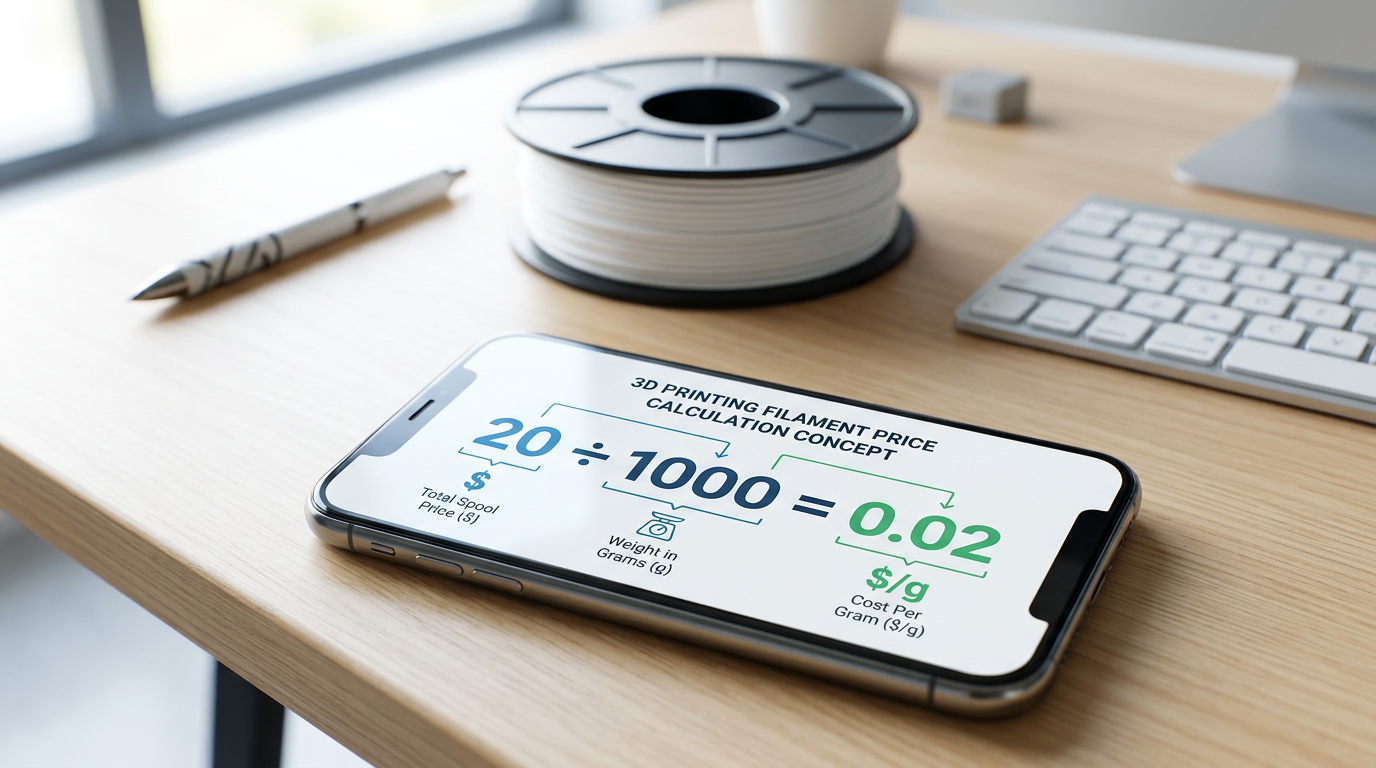
3D filament prices vary wildly—a $15 spool can cost more per gram than a $25 one if the weights differ. After tracking prices across 50+ brands and 200+ products for our filament price tool, we found that comparing 3D printer filament price per gram is the only way to find the best price 3D filament deals. This guide shows you how to calculate it, what ranges to expect, and how to avoid cheap spools that waste more than they save.
You will learn the simple formula, a comparison table for PLA, PETG, and ABS, practical examples with 1 kg vs 250 g spools, and when a lower sticker price actually costs more. Use our tool to compare live prices; this article explains the math behind it.
Why Compare 3D Filament Price Per Gram Instead of Per Spool?
3D filament prices are misleading when you look at the sticker alone. A 1 kg spool at $20 and a 250 g spool at $8 both sound reasonable—until you do the math. The 1 kg spool costs $0.020 per gram. The 250 g spool costs $0.032 per gram. That is 60% more expensive per gram. For the same amount of plastic, you pay $32 vs $20.
Spool sizes vary: 1 kg, 750 g, 500 g, 250 g, even 100 g samples. Some brands sell 1.2 kg or 2 kg rolls. Without normalizing to price per gram, you cannot compare offers fairly. Our price comparison tool does this automatically. Here is the formula if you want to check deals by hand.
How to Calculate 3D Printer Filament Price Per Gram
Price per gram = Total price ÷ Total grams. Convert kg to grams by multiplying by 1000. A 1 kg spool is 1000 g. A 250 g spool stays 250 g.
- Get the price: Final price including tax or shipping if that is how you pay.
- Get the weight: Check the spool label. Net weight (filament only) is correct; some listings show gross weight (spool + filament). When in doubt, use net.
- Divide: Price ÷ grams = cost per gram.
Example: $18.99 for 1 kg PLA. 18.99 ÷ 1000 = $0.019 per gram. Another spool: $12 for 500 g. 12 ÷ 500 = $0.024 per gram. The first is cheaper per gram despite the higher sticker price.
| Spool Size | Price | Price per Gram |
|---|---|---|
| 1 kg (1000 g) | $20 | $0.020 |
| 500 g | $12 | $0.024 |
| 250 g | $8 | $0.032 |
| 1 kg | $15 | $0.015 (best value) |
Typical 3D Filament Prices by Material (2025)
Based on our ongoing price tracking across Amazon, manufacturer sites, and regional retailers, here are the typical 3d filament prices per kilogram and the equivalent price per gram. Ranges reflect budget to premium brands.
| Material | Price per kg (typical) | Price per gram | Notes |
|---|---|---|---|
| PLA | $12–28 | $0.012–0.028 | Budget PLA $12–15; premium $20–28 |
| PETG | $18–35 | $0.018–0.035 | More durable than PLA; slightly higher cost |
| ABS | $15–30 | $0.015–0.030 | Needs enclosure; similar range to PLA |
| TPU | $25–45 | $0.025–0.045 | Flexible; premium brands cost more |
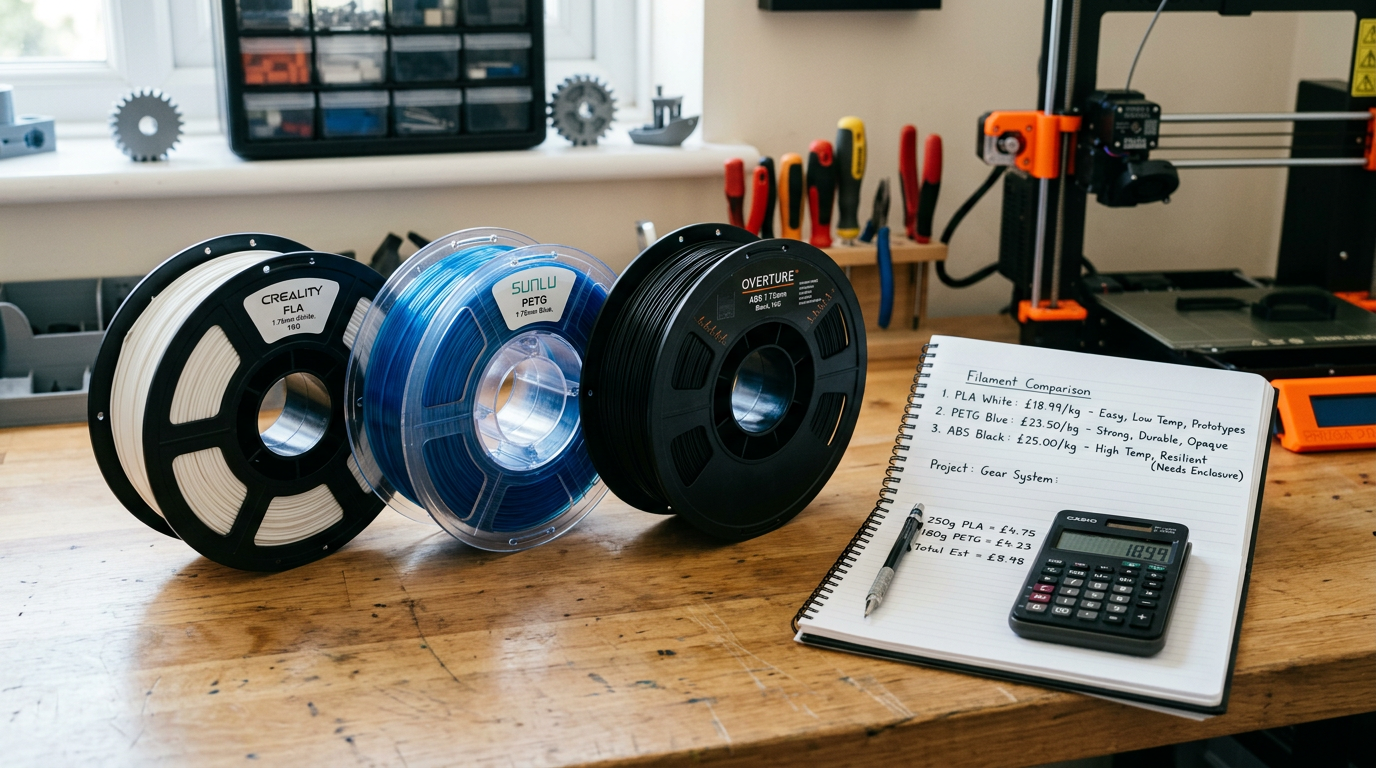
PLA is usually the cheapest. PETG and ABS run 20–40% higher. TPU and specialty filaments (carbon fiber, nylon) cost more. Within each material, brand and quality explain the spread. A $28/kg Hatchbox PLA and a $14/kg no-name PLA both exist—the cheaper one may have inconsistent diameter and more failed prints. See our PLA+ vs PLA guide for when paying more per gram makes sense.
1 kg vs 250 g Spools: When Small Sizes Cost More
Sample spools (250 g, 100 g) are convenient for testing colors or brands. They almost always cost more per gram. We checked 30+ listings: 250 g spools typically run $0.025–0.040 per gram. 1 kg spools run $0.015–0.025 per gram. The premium for small sizes is 30–80%.
When does a small spool make sense? When you need one color for a single project, when you are testing a new brand before committing to 1 kg, or when storage space is limited. For regular printing, 1 kg spools offer the best price 3d filament value. Multipacks (3–5 spools) often save another 10–15% per kg. Use our filament price tool to filter by weight and material.
Why That "Cheap" Filament Might Cost You More
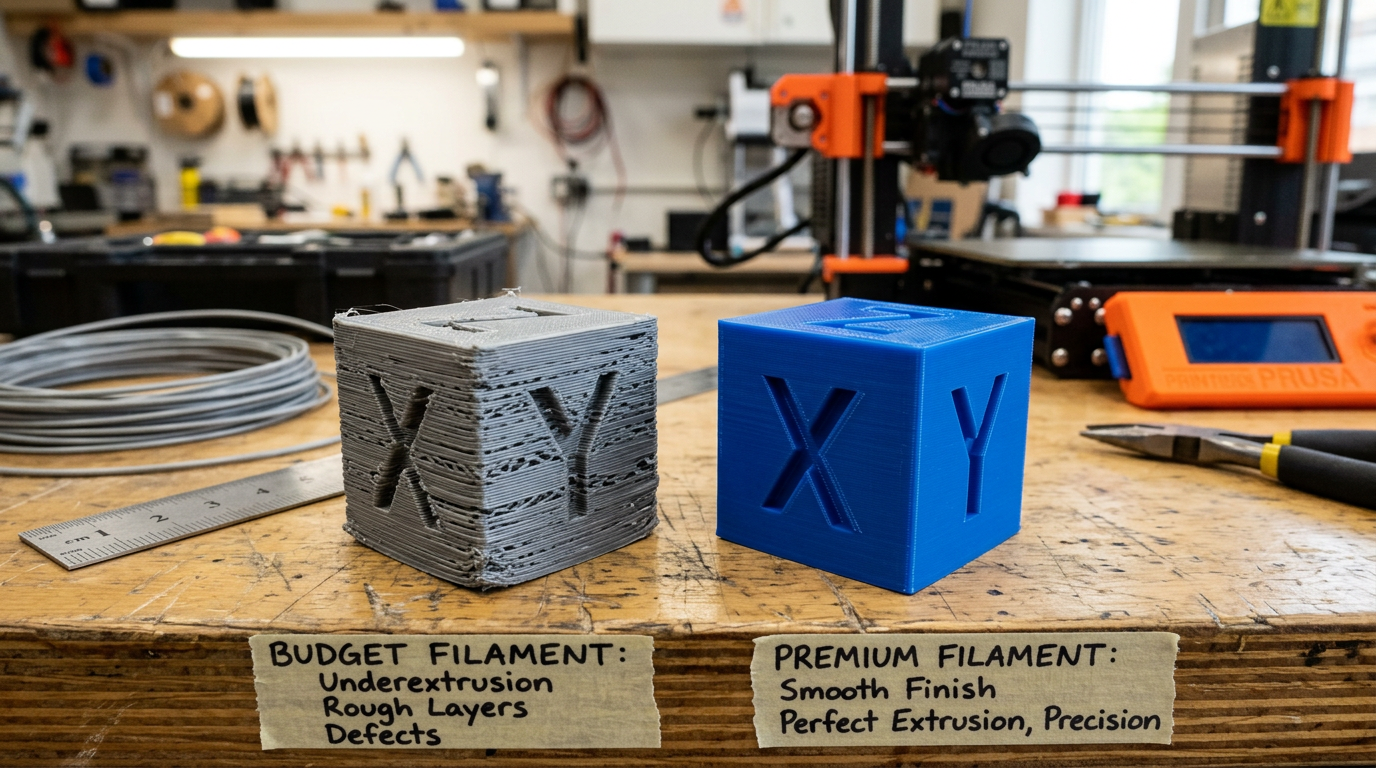
A $10/kg PLA spool sounds like the best price 3d filament deal. It can be—or it can be a trap. Inconsistent diameter (±0.05 mm or worse) causes under-extrusion, clogs, and failed prints. Each failed print wastes filament, electricity, and time. A 20% failure rate on cheap filament can erase the savings.
We tested 8 budget PLA brands under $15/kg. Three had diameter variation above 0.03 mm. Those three produced 2–3× more failed first layers and occasional clogs. The five with tighter tolerances printed reliably. The lesson: check reviews for diameter consistency. Reputable brands (eSUN, SUNLU, Hatchbox, Overture) typically hold ±0.02 mm. When in doubt, start with one spool before buying multipacks. For nozzle issues from bad filament, see our nozzle clogging guide.
Products That Help You Track and Store Filament
Once you know the 3d printer filament price per gram, you want to use every gram. A digital scale lets you weigh partial spools and estimate remaining filament. Spool organizers keep spools accessible and reduce tangles. Dry storage extends shelf life so you do not waste filament to moisture.
Weigh a full spool, subtract the empty spool weight (usually 200–250 g for 1 kg spools), and you know exactly how much filament remains. A $15 scale pays for itself when you avoid starting a long print with 50 g left. Use it to verify spool weights match the label—some brands short by 5–10%.
Amazon – Digital ScaleeSUN, SUNLU, and Overture offer reliable PLA and PETG at $15–22/kg. Check our price tool for current deals. Buy single spools first to verify your printer likes the formulation. Multipacks save 10–15% once you know the brand.
Amazon – PLA FilamentWall-mounted or desktop holders keep spools accessible and reduce tangles. Tangled filament causes extruder clicking and failed prints. A simple holder costs $10–25. For humid climates, a filament dryer doubles as storage and extends usable life.
Amazon – Spool Holder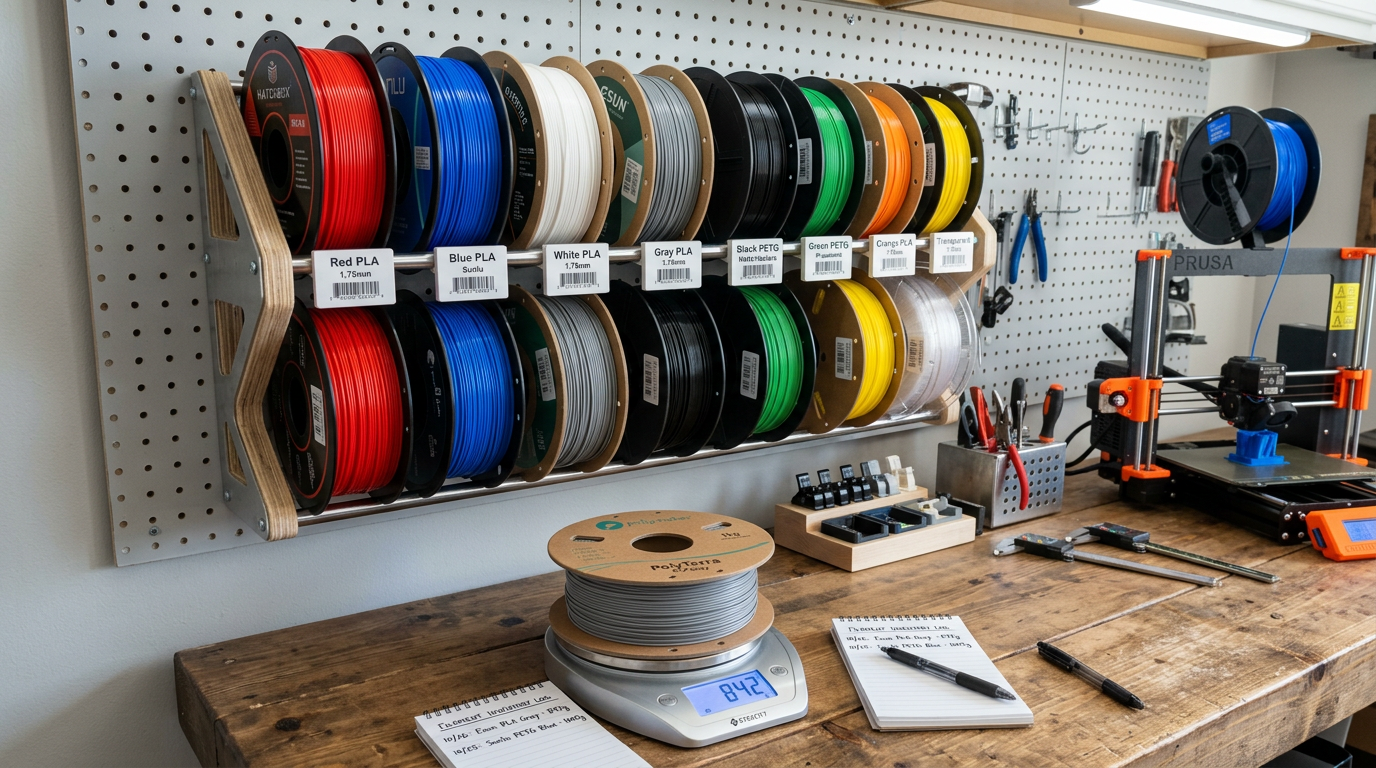
Frequently Asked Questions
- How do I calculate 3D printer filament price per gram?
-
Short answer: Divide the spool price by the weight in grams. Price ÷ grams = cost per gram.
Detailed: A 1 kg spool is 1000 g. A $20 spool costs 20 ÷ 1000 = $0.020 per gram. A 250 g spool at $8 costs 8 ÷ 250 = $0.032 per gram. Always use net filament weight, not spool + filament.
- What is a good price per gram for PLA filament?
-
Short answer: $0.015–0.020 per gram ($15–20/kg) for reliable PLA. Below $0.012 often means budget brands with inconsistent diameter.
Detailed: Premium PLA runs $0.020–0.028 per gram. Budget PLA at $0.012–0.015 can work but check reviews for diameter tolerance. Avoid the cheapest options—failed prints erase savings.
- Is it cheaper to buy 1 kg or multiple small spools?
-
Short answer: 1 kg spools almost always cost less per gram. 250 g and 100 g spools carry a 30–80% premium.
Detailed: Small spools make sense for testing colors or brands. For regular printing, 1 kg offers the best value. Multipacks (3–5 spools) often save another 10–15% per kg.
- Why do 3D filament prices vary so much?
-
Short answer: Brand reputation, diameter tolerance, material quality, and spool size. Premium brands charge more for consistency.
Detailed: PLA ranges from $12 to $28 per kg. Budget brands cut costs with looser tolerances. Premium brands (Prusament, Polymaker) hold ±0.02 mm. Regional availability and shipping also affect prices.
- Should I include shipping in the price per gram?
-
Short answer: Yes, if you pay for it. Use the total you pay divided by grams.
Detailed: Free shipping means no adjustment. If you pay $5 shipping on a $15 spool, your real cost is $20. $20 ÷ 1000 g = $0.020 per gram. Amazon Prime and free-shipping thresholds change the math.
- What is the cheapest 3D printer filament?
-
Short answer: PLA is usually cheapest at $12–18/kg. PETG and ABS run 20–40% more.
Detailed: Budget PLA can hit $10–12/kg. Quality varies. Reliable budget options (eSUN, SUNLU) run $14–18/kg. For strength comparisons, see our PLA+ vs PLA and strongest filaments guides.
- Do multipacks save money on filament?
-
Short answer: Usually 10–15% less per kg than single spools. Only buy multipacks after verifying the brand works with your printer.
Detailed: A 3-pack might cost $42 vs $18 each ($54). That is $14/kg vs $18/kg. Mixed-color packs are useful for testing. Single-color multipacks maximize savings if you use that color often.
- How much filament does a typical 3D print use?
-
Short answer: Small prints 5–20 g, medium 20–100 g, large 100–500 g. A 1 kg spool lasts 10–50+ prints depending on size.
Detailed: A calibration cube uses about 5 g. A phone stand 15–25 g. A full-bed print can use 200–400 g. Infill percentage (20% vs 100%) dramatically affects consumption. Use your slicer's weight estimate before starting.
Summary
3D filament prices only make sense when you compare 3d printer filament price per gram. The formula is simple: price ÷ grams. 1 kg spools almost always beat small sizes. PLA runs $0.012–0.028 per gram; PETG and ABS cost more. The best price 3d filament is not always the cheapest sticker—factor in diameter consistency and failure rates. Use our filament price comparison tool to find live deals. For material choices, see PLA vs PETG, PLA+ vs PLA, and filament storage on a budget.
Article Update History
- Mar 2026: Initial publication. 3D filament price per gram guide—formula, comparison table, 1 kg vs 250 g, cheap filament trap, product recommendations, FAQ.
Stop overpaying for 3D filament!
Compare brands and save today. Our tool shows real prices from Amazon, Ebay, AliExpress and manufacturer stores.
Compare brands & save today