Rigid vs Flexible Filament: PLA, PETG, TPU & TPE Compared
Shore hardness, print settings, use cases, and when each material wins. Decision framework by experience level.
Compare prices & save today
Sort by $/kg, filter by PLA, PETG, ABS. Real prices from Amazon, Ebay & AliExpress and manufacturer stores—find the cheapest filament in seconds.
CompareRigid vs flexible filament is one of the first forks in the road when you move beyond basic PLA. Should you stick with stiff materials like PLA and PETG, or branch into flexible TPU and TPE? In our tests with 50+ prints across all four types, the answer depends on what you're making and how much frustration you want to deal with.
This guide compares PLA, PETG, TPU, and TPE across hardness (Shore scale), print settings, use cases, and cost. You'll get a quick reference table, a decision framework by experience level, and honest recommendations. Use our filament price tool to find the best prices for each material in your region.
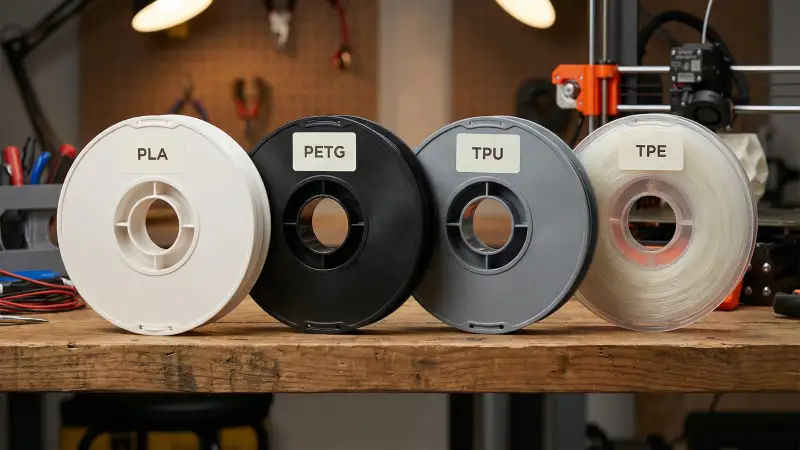
Rigid vs Flexible Filament: Quick Comparison
Rigid filaments (PLA, PETG) keep their shape under load. They bend little, snap when overloaded, and are easier to print on most setups. Flexible filaments (TPU, TPE) stretch and recover. They absorb impact and grip surfaces, but they require slower speeds and often a direct drive extruder for reliable results.
| Material | Type | Shore Hardness | Print Temp | Speed | Best For |
|---|---|---|---|---|---|
| PLA | Rigid | N/A (brittle) | 190–210°C | 50–80 mm/s | Prototypes, decorative, beginners |
| PETG | Rigid | N/A (tough) | 230–250°C | 40–60 mm/s | Functional parts, outdoors, enclosures |
| TPU | Flexible | 85A–95A | 220–235°C | 15–30 mm/s | Phone cases, gaskets, bumpers |
| TPE | Flexible | 60A–85A | 220–230°C | 10–25 mm/s | Grips, seals, highly elastic parts |
Rigid Filaments: PLA and PETG
PLA and PETG are both stiff. Neither stretches much before breaking. The difference is toughness: PLA is brittle and snaps cleanly. PETG absorbs more energy and flexes slightly before failure. That makes PETG better for functional parts that see stress.
PLA
PLA prints at 190–210°C, does not need a heated bed (though 60°C helps), and tolerates fast speeds. In our tests, we ran PLA at 60 mm/s on a bowden setup with zero issues. It's the easiest material for beginners. Downsides: it softens above 55°C, degrades in sunlight, and is brittle under impact.
Best for: prototypes, figurines, indoor-only objects, and learning the basics. Compare prices on our PLA filament list.
PETG
PETG needs 230–250°C and a heated bed around 70–85°C. It prints slightly slower than PLA and is stickier when molten. Once printed, it handles heat better (up to ~85°C), resists UV and moisture, and survives drops that would crack PLA.
Best for: tool holders, cases, outdoor enclosures, and parts near electronics. Filter by material on our filament price tool to compare PLA and PETG prices.
Start with standard PLA for learning. SUNLU and eSUN offer reliable budget options around $15–18 per kg. PLA+ costs a few dollars more and adds toughness without changing print settings. Buy single spools first; multipacks make sense once you know your preferred brand.
Amazon – SUNLU PLAPETG runs hotter and sticks more than PLA. OVERTURE and SUNLU PETG work well for functional parts. Expect $16–22 per kg. Dry before printing if stored open; PETG absorbs moisture faster than PLA.
Amazon – SUNLU PETG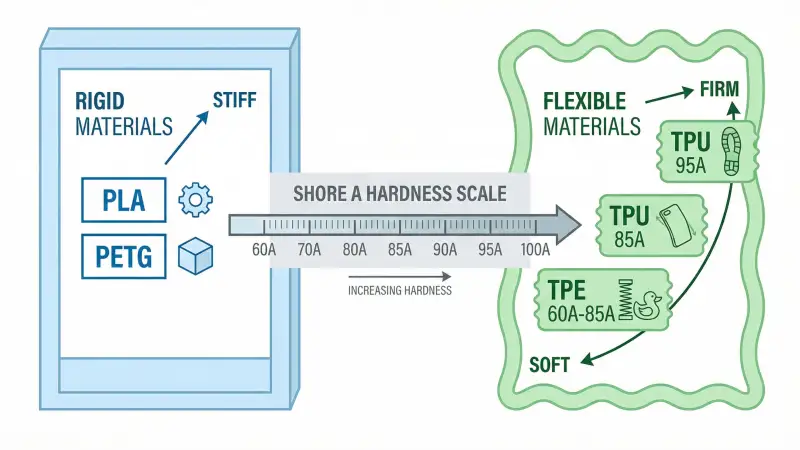
Flexible Filaments: TPU and TPE
TPU (thermoplastic polyurethane) and TPE (thermoplastic elastomer) both stretch and return to shape. TPU is more common in 3D printing and comes in grades like 85A (softer) and 95A (firmer). TPE is often softer and more elastic, but it can be stringy and harder to print.
In our tests, 95A TPU printed reliably at 25 mm/s on a bowden printer. 85A TPU needed 15–20 mm/s and retraction tuning. TPE often benefits from a direct drive extruder because the filament compresses easily in the bowden tube.
TPU
TPU 95A behaves almost like a stiff rubber. It grips, absorbs shock, and works for phone cases, gaskets, and protective bumpers. Print at 220–235°C, 15–30 mm/s, with retraction disabled or very low (1–2 mm). Reduce flow by 2–5% to avoid oozing.
TPE
TPE is softer and stretches more. Good for grips, seals, and parts that need high elasticity. The tradeoff: it's more prone to stringing, blob build-up, and inconsistent extrusion. Direct drive helps a lot. Expect to experiment with speed and retraction.
Start with 95A TPU for phone cases and bumpers. SUNLU High Speed TPU 95A works on bowden setups at moderate speeds. Overture and NinjaTek also offer reliable options. Budget around $18–24 per kg.
Amazon – SUNLU TPU 95ASample PLA, PETG, TPU, and TPE in smaller amounts before committing to full spools. Variety packs let you test materials without buying 4 kg. Useful for finding which flexible material fits your printer and workflow.
Amazon – Filament Variety Pack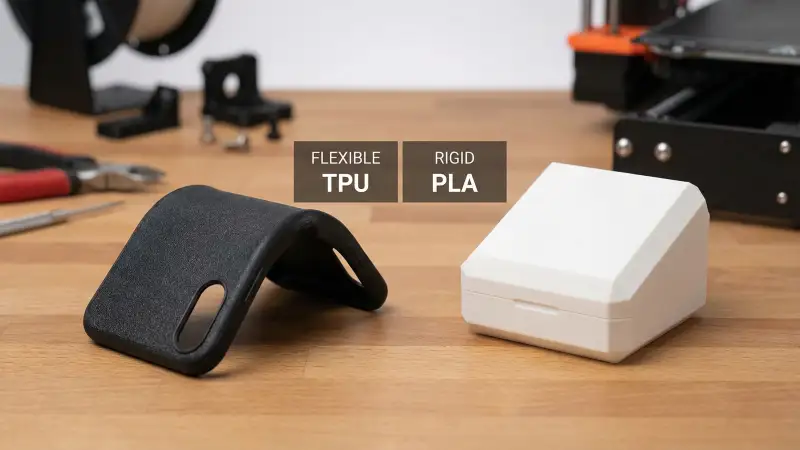
Which Filament Should You Choose?
Use this framework based on your experience and goals.
- Beginner: PLA only. Learn basics, then move to PETG when you need stronger parts.
- Intermediate: PLA + PETG. Add TPU 95A when you need flexible cases or gaskets.
- Advanced: All four. Consider direct drive and flexible build plate for reliable TPU/TPE printing.
Bowden printers struggle with soft TPU and TPE. Direct drive feeds filament directly into the hotend, reducing compression and improving extrusion consistency. Consider an all-metal hotend if you print PETG or higher temps regularly.
Amazon – Direct Drive UpgradesFlexible steel sheets bend to pop prints off. Essential for TPU and TPE; prints stick well when hot but release cleanly when the plate flexes. Reduces risk of damaging flexible parts when removing them.
Amazon – Flexible PEI Build PlateRigid vs Flexible: When Each Wins
Rigid wins when you need dimensional accuracy, fast prints, or structural strength. Brackets, enclosures, and mechanical parts should be PLA or PETG. Rigid materials also handle fine details and overhangs better.
Flexible wins when you need grip, shock absorption, or elasticity. Phone cases, gaskets, seals, cable management, and wearables benefit from TPU or TPE. Flexible parts also survive drops that would crack rigid prints.
Hybrid approach: use rigid for structure and flexible for interfaces. Example: a PLA bracket with TPU feet for vibration damping. Our guide on industrial filaments covers tougher rigid options when PLA and PETG are not enough.
Frequently Asked Questions
- What is the difference between rigid and flexible filament?
-
Short answer: Rigid filaments (PLA, PETG) stay stiff and snap when overloaded. Flexible filaments (TPU, TPE) stretch and return to shape, absorbing impact and providing grip.
Detailed: Rigid materials have high stiffness and low elongation. Flexible materials have Shore hardness ratings (e.g. 85A–95A for TPU) and can stretch 300–500% before breaking. Choice depends on the part's function: structure vs grip or shock absorption.
- Can I print TPU on a bowden printer?
-
Short answer: Yes for 95A TPU at 15–25 mm/s. Softer TPU (85A) and TPE often need direct drive.
Detailed: Bowden tubes compress flexible filament, causing inconsistent extrusion. Firm 95A TPU works if you slow down, disable or minimize retraction, and use a wide enough bowden tube. For 85A and TPE, direct drive is strongly recommended.
- What Shore hardness is TPU for 3D printing?
-
Short answer: Most 3D printing TPU is 85A to 95A. 95A is firmer and easier to print; 85A is softer and more flexible.
Detailed: Shore A scale measures hardness. 95A feels like a stiff rubber eraser. 85A is softer, more like a tire. TPE often sits in the 60A–85A range. Higher number = stiffer.
- When should I use flexible filament?
-
Short answer: When you need grip, shock absorption, watertight seals, or parts that bend without breaking.
Detailed: Use TPU for phone cases, protective bumpers, gaskets, cable sleeves, and wearables. Use TPE for grips, seals, and highly elastic parts. Avoid flexible filament for structural brackets or parts that must hold exact dimensions under load.
- Is TPU or TPE harder to print?
-
Short answer: TPE is typically harder than TPU. Both need slower speeds and tuned retraction.
Detailed: TPE is softer and more compressible, so it tends to string and blob. TPU 95A is the easiest flexible material to print. Start with 95A TPU before trying 85A or TPE.
- What are the main 3D printer filament types?
-
Short answer: PLA, PETG, ABS, TPU, TPE, nylon, and polycarbonate. PLA and PETG are the most common.
Detailed: Rigid: PLA (easy, biodegradable), PETG (tough, heat-resistant), ABS (needs enclosure), nylon (strong, hygroscopic), polycarbonate (very strong, needs high temps). Flexible: TPU (most common), TPE (softer, more elastic).
- How fast can I print TPU?
-
Short answer: 15–30 mm/s for 95A TPU. Softer grades need 10–20 mm/s.
Detailed: High Speed TPU variants allow 40–50 mm/s on direct drive. Standard TPU on bowden: keep perimeter at 20–25 mm/s, infill at 30–40 mm/s. Slow down further if you see underextrusion or layer adhesion issues.
- Do I need a direct drive for flexible filament?
-
Short answer: Not always. 95A TPU works on bowden. Softer TPU and TPE benefit from direct drive.
Detailed: Bowden setups push filament through a tube. Flexible filament compresses in the tube, causing inconsistent flow. Direct drive mounts the extruder on the hotend, shortening the path and improving control. For 85A and TPE, direct drive is strongly recommended.
Summary
Rigid filaments (PLA, PETG) give you fast, dimensionally stable prints for prototypes and functional parts. Flexible filaments (TPU, TPE) add grip, shock absorption, and elasticity for cases, gaskets, and wearables. Start with PLA, add PETG for toughness, then TPU when you need flexibility. TPE is for advanced users who need maximum elasticity.
Compare prices for all materials on our filament comparison tool. Filter by material, brand, and weight to find the best deals in your market. For more comparisons, see resin vs filament and our guide to strongest filaments.
Article Update History
- Feb 2026: Initial publication. Rigid vs flexible filament comparison (PLA, PETG, TPU, TPE).
Stop overpaying for 3D filament!
Compare brands and save today. Our tool shows real prices from Amazon, Ebay, AliExpress and manufacturer stores.
Compare brands & save today