Resin vs. Filament 3D Printing (2026 Guide)
Motorcycle vs pickup truck, neither is 'better.' Hidden costs, workflows, safety, and which one belongs in your workshop.
Compare prices & save today
Sort by $/kg, filter by PLA, PETG, ABS. Real prices from Amazon, Ebay & AliExpress and manufacturer stores—find the cheapest filament in seconds.
CompareIf you've spent any time researching 3D printers, you've probably hit a wall of confusion. You see smooth miniatures from resin printers and massive durable helmets from filament printers. You ask yourself which one to get. After three years knee-deep in both plastic spaghetti and sticky resin vats, I'll save you time: that's the wrong question.
Comparing Resin (SLA/MSLA) and Filament (FDM) printers is like comparing a motorcycle to a pickup truck. Both are vehicles. Both get you from point A to point B. But if you try to haul a sofa with a motorcycle, you're going to have a bad time. Similarly, if you try to weave through rush hour traffic in a monster truck, you'll be stuck.
In this 2026 guide, I'm putting aside the marketing hype. We aren't just looking at specs. We're looking at the lifestyle, the hidden costs, and the daily reality of living with these machines. By the end, you'll know exactly which one belongs in your workshop.
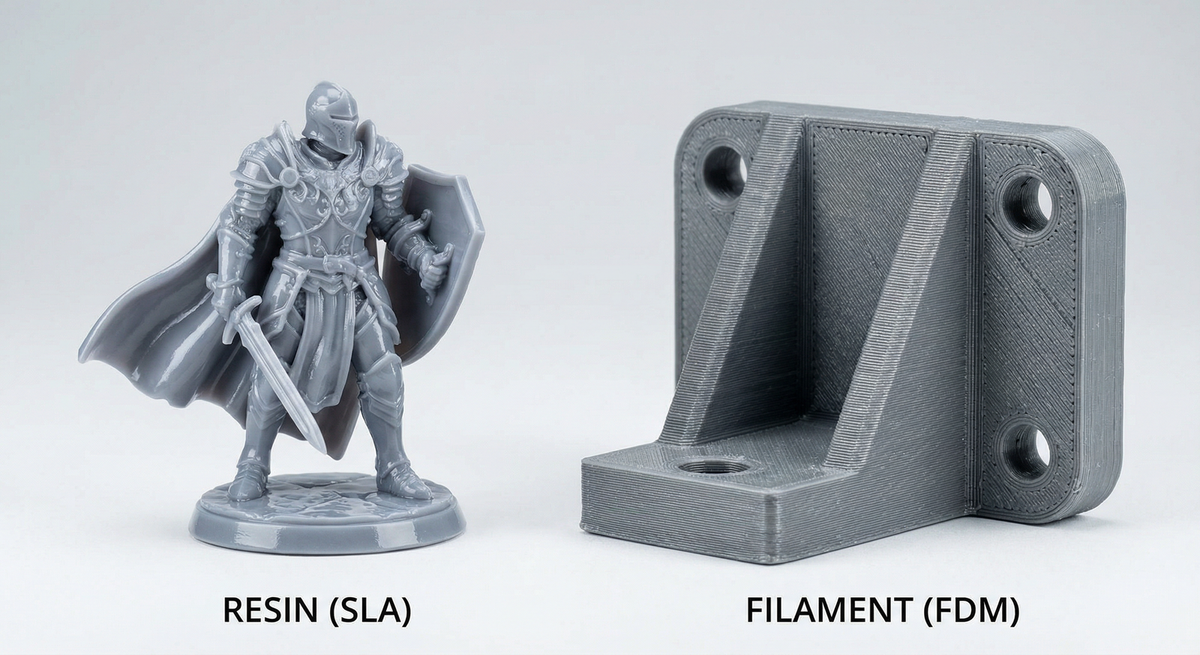
Hot Glue vs. UV Lasers
To understand the pros and cons, you have to understand how different these technologies actually are.
Filament (FDM – Fused Deposition Modeling)
Think of a filament printer like the Bambu Lab A1 Mini or Creality Ender 3 V3 as a computer-controlled hot glue gun. It takes a spool of hard plastic wire, melts it, and draws your object layer by layer from the bottom up. It's mechanical, logical, and tough.
Resin (SLA/DLP – Stereolithography)
Resin printing is more like photography. The printer dips a build plate into a vat of liquid photosensitive resin. An LCD screen at the bottom flashes an image of a single layer in UV light, instantly hardening the liquid into solid plastic. It repeats this thousands of times. It's chemical, messy, but incredibly precise.
Day in the Life
This is the single biggest factor spec sheets don't show you. How does using the machine actually feel on a Tuesday evening after work?
Living with Filament
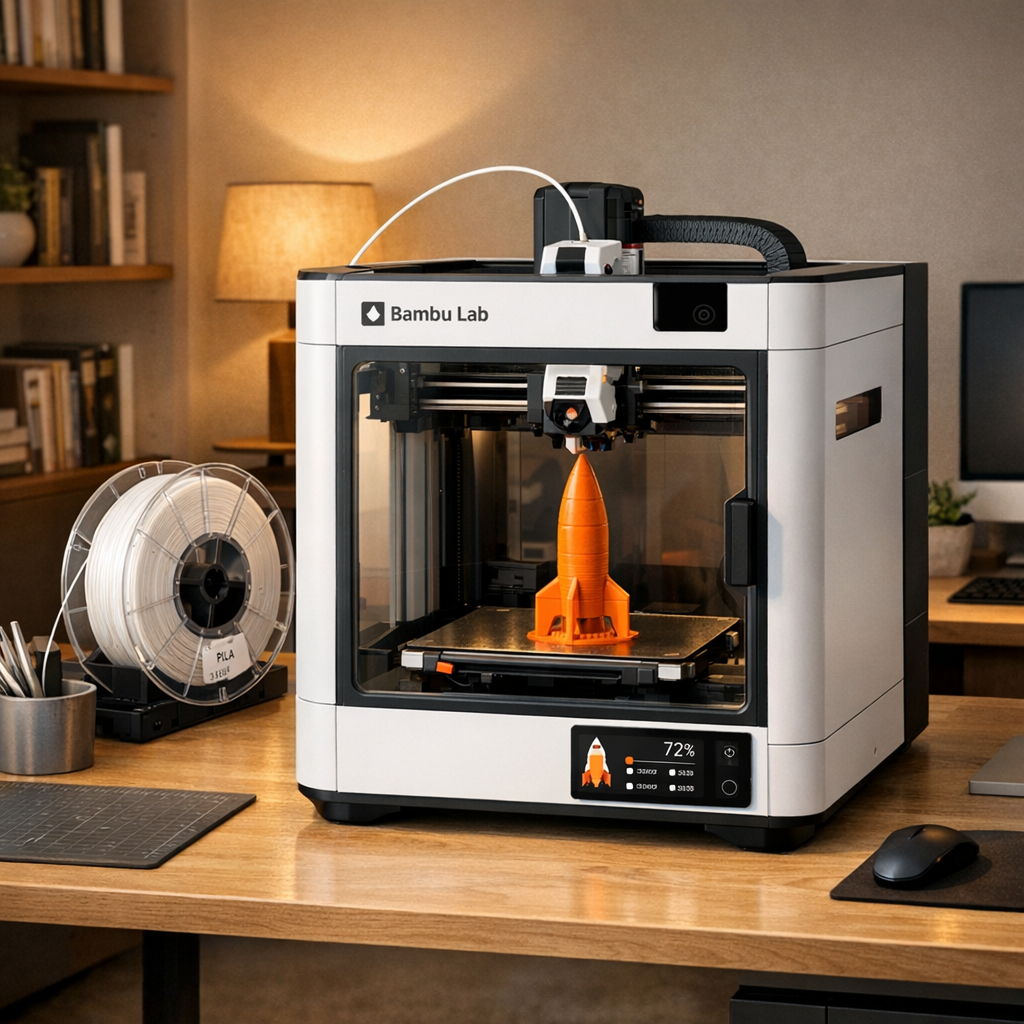
Modern filament printing has become remarkably appliance-like. With a machine like the Bambu Lab A1 Mini:
- Slice your file. Takes a couple minutes
- Hit print and walk away
- Come back hours later, pop the item off the plate, hand it to your kid. Done.
It's clean. It's dry. No chemicals. You can keep the printer on your office desk.
Living with Resin
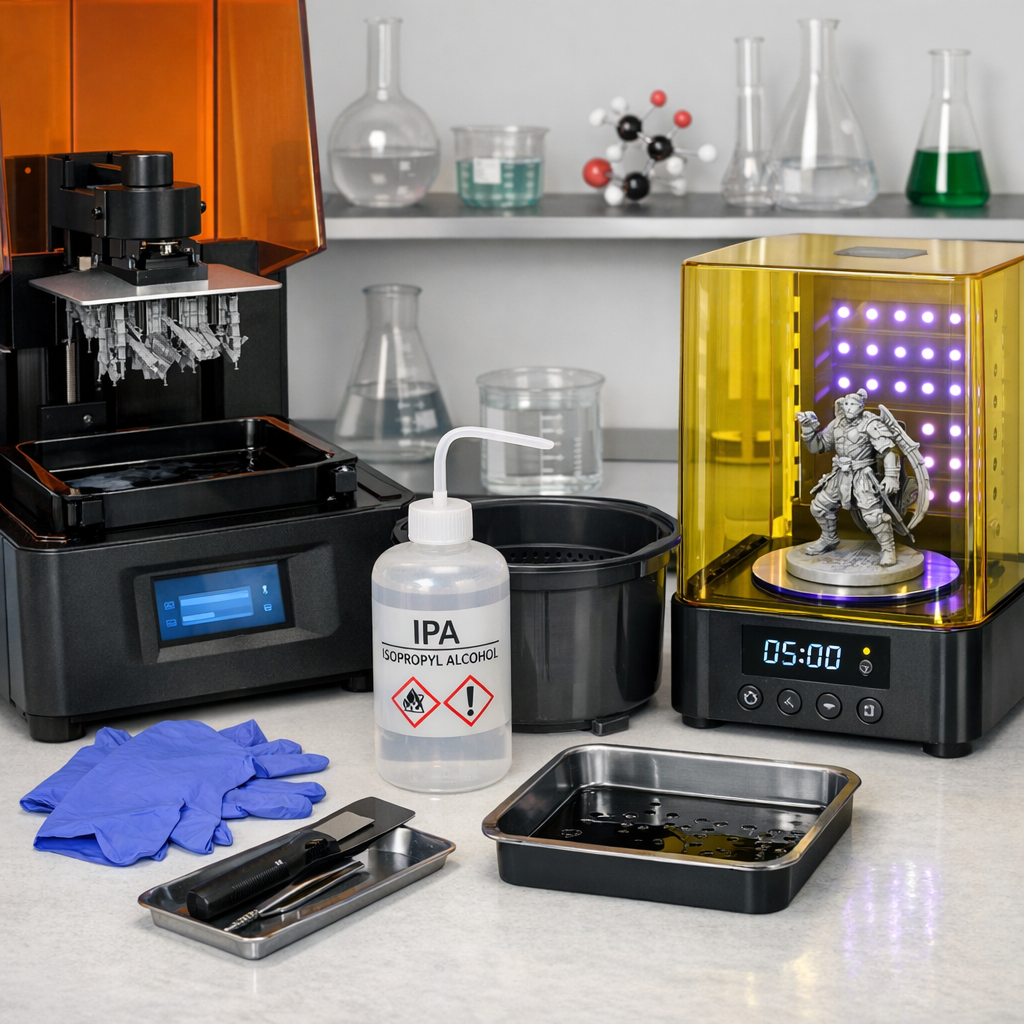
Resin printing asks more of you. When a print finishes:
- Put on a mask and nitrile gloves
- Carefully remove the build plate without dripping toxic liquid everywhere
- Scrape the soft model into a bath of alcohol
- Wash for 10 minutes to remove excess resin
- Remove supports. That part gets messy
- Place in a UV curing station for another 5–10 minutes
- Clean the vat, filter resin back into the bottle, wipe everything with IPA
Reality check: Without a dedicated workspace like a garage or well-ventilated room, resin is a nightmare. Fumes give headaches, and sticky residue ends up on doorknobs and light switches.
Detail vs. Strength
This is what usually decides it.
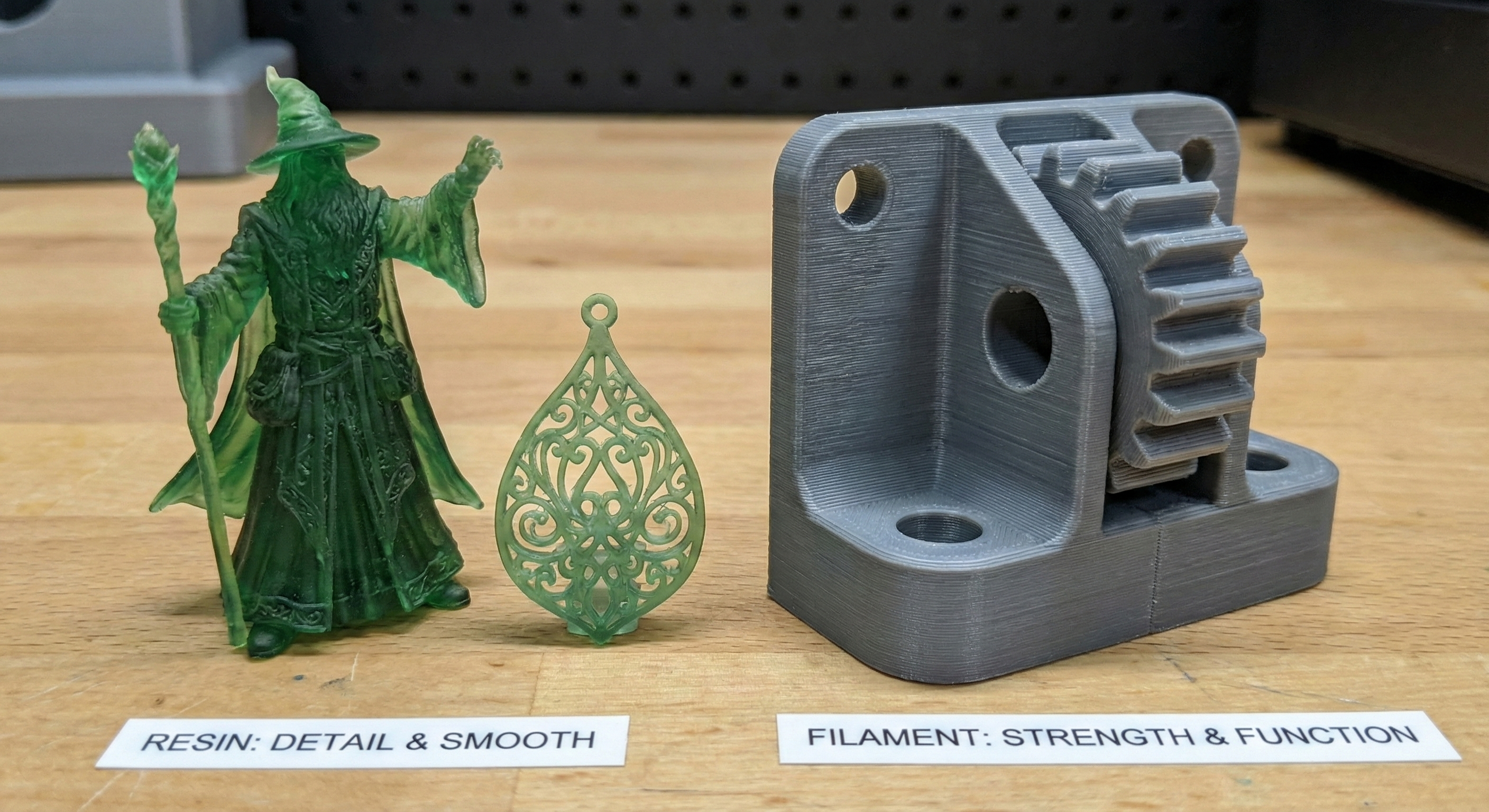
Resin: The King of Detail
If you want D&D miniatures, jewelry molds, or highly detailed display statues, resin is the only real option.
Resin printers can print layers as thin as 0.03 mm. The result is a surface so smooth it looks like it came from an injection mold factory. You can print a 28 mm tall warrior and see the buckles on his boots.
Filament: The King of Function
Filament printers struggle with microscopic detail. You'll always see faint layer lines. But filament prints are strong.
I ran a stress test: a hook in standard resin vs. PLA filament.
- The resin hook snapped under 4 kg. Shattered like glass
- The filament hook held 8 kg and bent slowly without snapping
For cosplay armor, shelf brackets, tool organizers, or toys that get dropped, you need filament. Resin is too brittle for functional parts unless you buy expensive engineering-grade resins.
Safety
Safety matters more than a lot of beginners think.
Filament (PLA/PETG) is generally safe. PLA is made from cornstarch; it smells a bit like waffles when printing and releases minimal particles. Safe in a home environment with basic ventilation.
Resin is a skin irritant and pollutant. Liquid resin is toxic to aquatic life. Never pour it down the drain. It can cause severe allergic reactions, and fumes from both resin and IPA need real ventilation. I'd strongly advise against keeping a resin printer in your bedroom or living room.
Which One Is You?
Still unsure? See which side fits you better.
Buy a Filament Printer If:
- Maker/Tinkerer: You want to print brackets, fix things, prototype inventions
- Limited space: You live in an apartment, no separate workshop
- Parent: You want a safe, educational tool for children
- Hate mess: You want something you can set and forget
- Cosplay: Large, lightweight, durable props
Buy a Resin Printer If:
- Tabletop gamer: Warhammer 40k or D&D minis. Quality is the only metric
- Model painter: You enjoy post-processing and painting more than printing
- Jeweler: You need castable resins for professional work
- Have a garage: Dedicated space where fumes and mess won't bother anyone
My Recommendations for 2026
If I were spending my own money today, here's what I'd buy.
-
Best Starter for Most People: Filament
Two years ago I would have said Ender 3. Not anymore. The A1 Mini calibrates itself, rarely fails, and offers multi-color. Less tinkering, more creating. Compatible PLA is easy to find.
Best for beginners, parents, makers.
-
The Miniature Factory: Resin
If you're here for the minis, Elegoo offers the best balance of price and performance. The Ultra series is fast and reliable. Pair it with a Mercury Wash & Cure Station. Don't try to wash prints manually in tupperware. You'll regret it.
Best for: Gamers and painters.
Budget option: Creality Ender 3 V3 SE. Around $200, solid for learning.
Quick FAQ
- Which is cheaper to run long-term?
- Filament. Resin needs IPA, gloves, FEP. The consumables add up. Roughly 50–70% more to run over a year.
- Can I print miniatures with a filament printer?
- Yes, but quality won't match resin. You'll see layer lines. For tabletop gaming, resin is the standard.
- Is resin printing safe at home?
- Only with proper ventilation. Don't put it in bedrooms or living rooms. Use a garage or well-ventilated room.
- Which should I buy first?
- Start with filament. It's forgiving, affordable, and fun. Add resin later for specialized detail work if you get hooked.
Final Thoughts
There is no single better printer. Only the right tool for the job.
If you're new to 3D printing, start with filament. It's forgiving, affordable, fun. You learn the basics without dealing with toxic chemicals. Once you're hooked, you can add a resin printer later for those detail-heavy projects.
Stop overpaying for 3D filament!
Compare brands and save today. Our tool shows real prices from Amazon, Ebay, AliExpress and manufacturer stores.
Compare brands & save today