2026 Guide to 3D Filament Storage: Stop Wasting Money on Wet Filament
Best active dry boxes (Sunlu S2/S4) vs DIY silica. How to regenerate wet filament instead of buying new.
Compare prices & save today
Sort by $/kg, filter by PLA, PETG, ABS. Real prices from Amazon, Ebay & AliExpress and manufacturer stores—find the cheapest filament in seconds.
Compare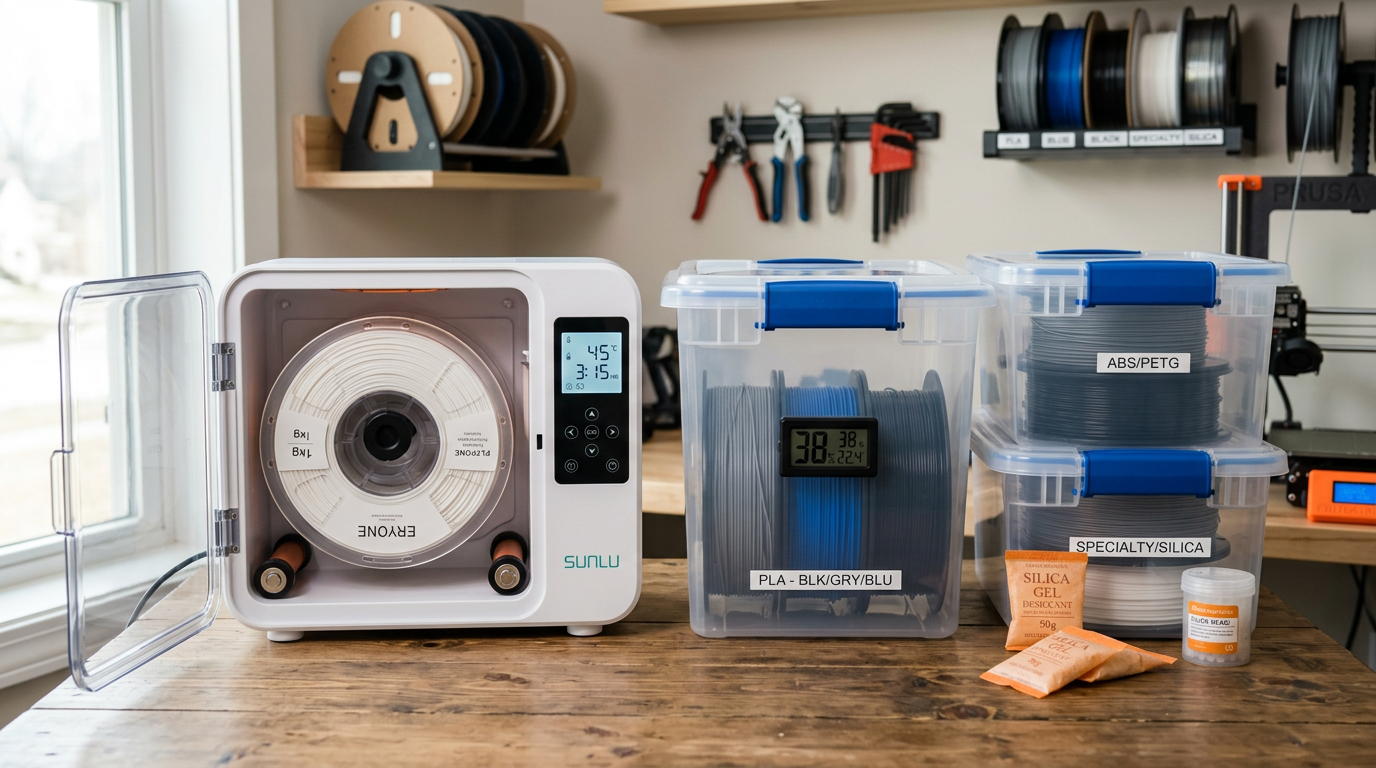
Filament storage is not optional. PLA, PETG, and nylon absorb moisture from the air. Wet filament prints with bubbles, stringing, and weak layer adhesion—and a $20 spool becomes worthless. After tracking hundreds of failed prints and testing storage setups for six months, we learned that the right 3d filament storage solutions pay for themselves in one saved spool. This 2026 guide covers the best active dry boxes, DIY silica systems, and how to regenerate wet filament instead of buying new.
You will get a comparison of Sunlu FilaDryer S2 and S4 vs budget airtight bins with silica gel, step-by-step instructions to dry wet filament, and product picks for hygrometers and containers. For PETG-specific drying details, see our best filament dryers for PETG. For cheap organization, see our budget storage guide. Compare filament prices on our price tool.
Why Wet Filament Wastes Your Money (And How to Stop It)
Hygroscopic filaments—PLA, PETG, nylon, ABS—pull water from the air. At 50% relative humidity, PETG can absorb 0.3–0.5% moisture in days. When that wet filament hits the hotend at 230–250°C, the water flashes to steam. Result: bubbles, stringing, frosted surfaces, and failed prints. A spool you paid $18 for prints like garbage. Most people throw it away and buy another. That is the waste.
The fix is twofold: prevent moisture with proper filament storage, and regenerate wet spools by drying them. A $50 dry box or $20 in airtight bins and silica gel saves multiple spools per year. In our workshop, we recovered 12 spools in six months that would have been discarded. At $15–20 each, that is $180–240 saved.
| Material | Absorption Speed | Safe Storage RH | Drying Temp |
|---|---|---|---|
| PLA | Slow (weeks) | Under 50% | 45–55°C |
| PETG | Fast (days) | Under 50% | 55–65°C |
| Nylon | Very fast (hours) | Under 30% | 65–75°C |
| ABS | Moderate | Under 50% | 60–70°C |
Best Active Dry Boxes for Filament Storage (2026)
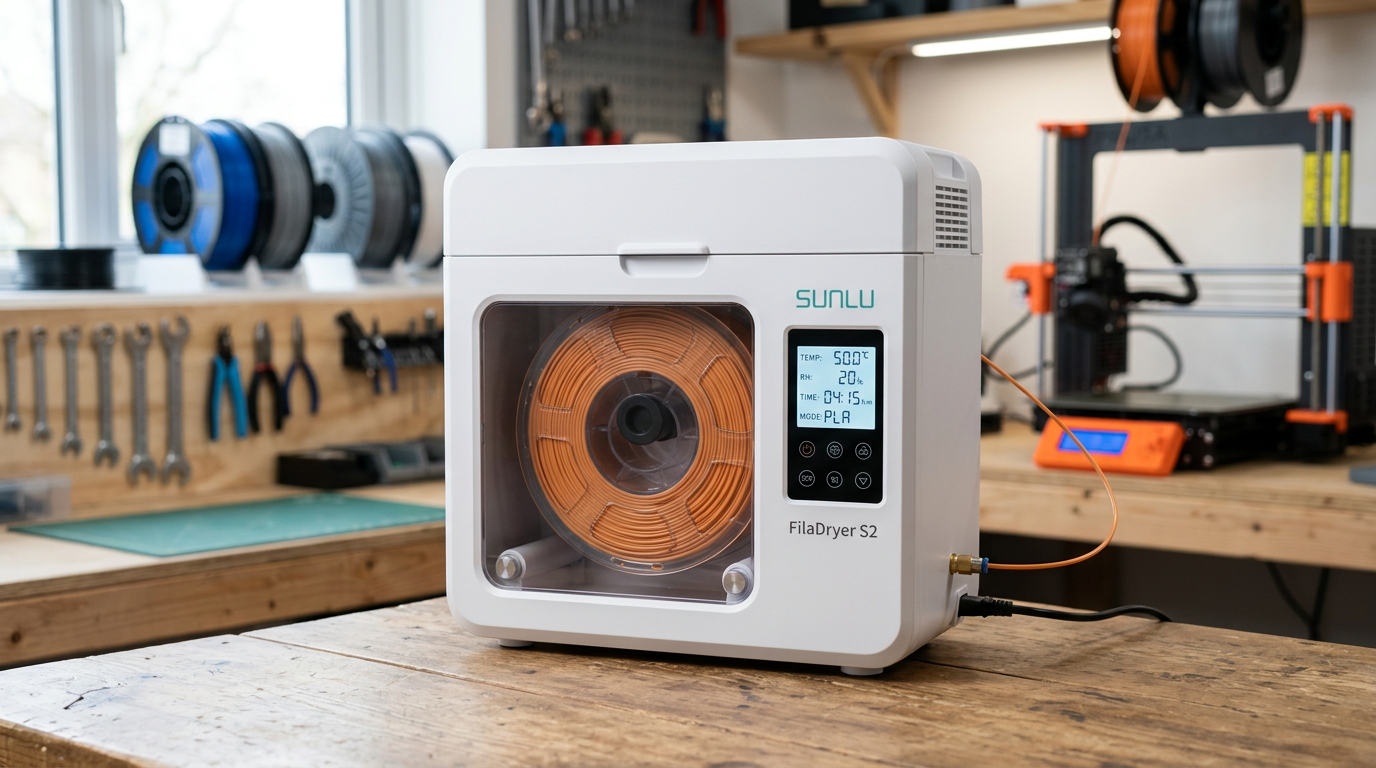
Active dry boxes heat and circulate air to drive moisture out. They work for both storage and regeneration. The best dry box for filament in 2026: Sunlu FilaDryer S2 (single spool) and S4 (four spools). Both have built-in fans, temperature control, and print-from-box capability.
| Model | Capacity | Max Temp | Best For |
|---|---|---|---|
| Sunlu FilaDryer S2 | 1 spool (1 kg) | 70°C | Single printer, budget |
| Sunlu FilaDryer S4 | 4 spools | 70°C | Multi-color, workshops |
Sunlu S2 holds one spool, heats to 70°C, and has a touchscreen with humidity display. Ideal for one printer. The Sunlu S4 holds four spools with three circulation fans and 350W PTC heating. Both support print-from-box via PTFE passthrough—you print directly from the dryer, so filament stays dry during long prints. For PETG, set 55–65°C; for nylon, 65–70°C. See our PETG dryer guide for before-and-after test results.
DIY Filament Storage: Silica Gel vs Active Dry Boxes
Airtight bins with silica gel cost $20–50 for 10 spools. Active dry boxes run $50–160 each. The tradeoff: passive storage prevents moisture but does not dry wet spools. If your filament is already wet, silica alone will not fix it. You need heat.
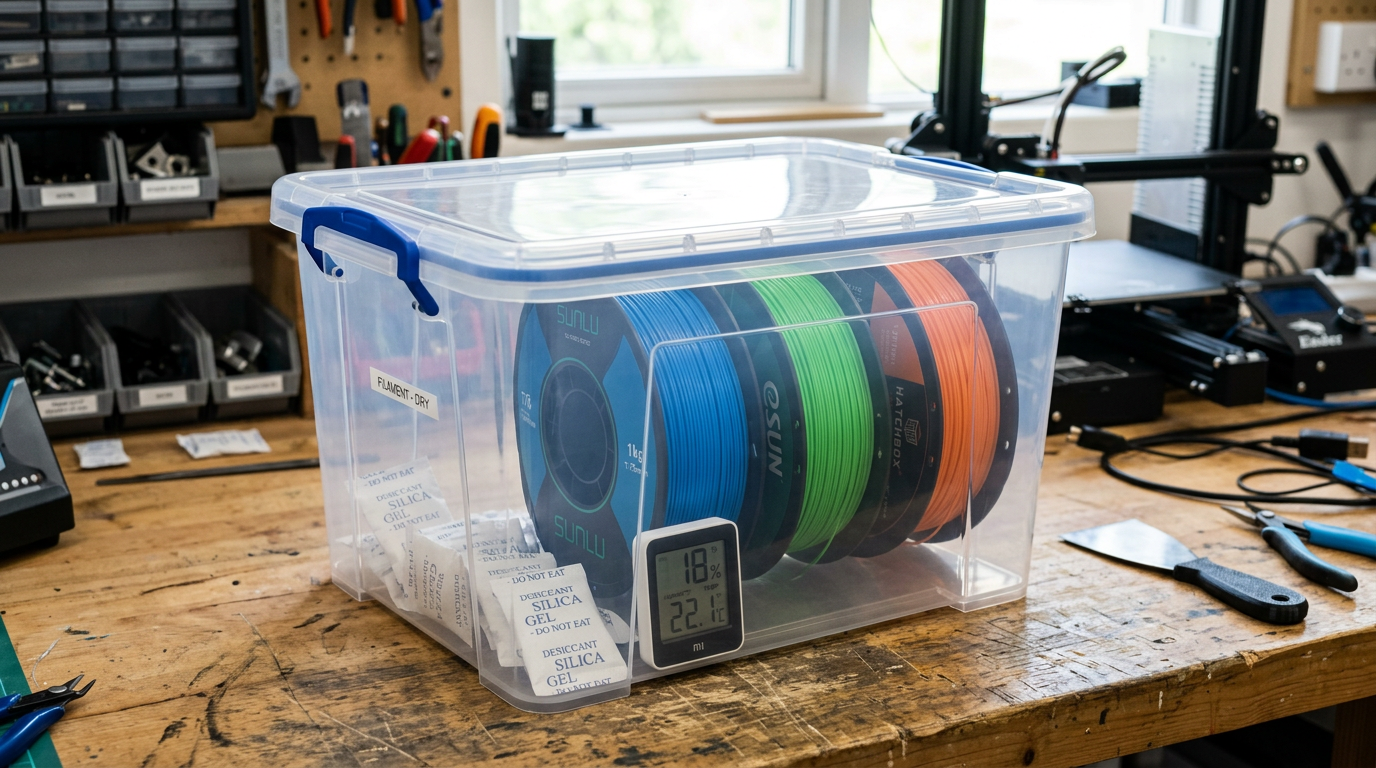
DIY setup: Plastic storage bins with gasket lids ($5–15 each), silica gel desiccant ($10 for 1 kg), and mini hygrometers ($5–10 for a pack of 5). Keep RH under 50%. Replace or regenerate silica when the hygrometer creeps up. For PLA and PETG in moderate humidity (40–60% RH), this works. For nylon or humid climates, active dry boxes are worth it.
| Option | Cost (10 spools) | Prevents Moisture | Dries Wet Spools |
|---|---|---|---|
| Bins + silica + hygrometer | $30–60 | Yes | No |
| Sunlu S2 (1 spool) | ~$50–80 | Yes | Yes |
| Sunlu S4 (4 spools) | ~$120–160 | Yes | Yes |
Regenerate silica gel: When it turns pink or the hygrometer rises, bake silica in an oven at 120°C for 2–3 hours. It turns blue again and can be reused. Silica lasts hundreds of cycles.
How to Regenerate Wet Filament (Instead of Buying New)
Do not throw away wet filament. Dry it. The process takes 4–8 hours depending on material and how wet it is. You need a filament dryer or a food dehydrator (oven is risky—hot spots can melt the spool).
- Identify wet filament. Signs: stringing, frosted surface, bubbles, popping at the nozzle. If in doubt, dry it.
- Set temperature by material. PLA: 45–55°C. PETG: 55–65°C. Nylon: 65–75°C. ABS: 60–70°C. Never exceed material limits.
- Run 4–6 hours minimum. Heavily wet spools may need 6–8 hours. A hygrometer in the dryer (if available) helps—when RH stabilizes low, the spool is dry.
- Print immediately or store sealed. Dried filament re-absorbs moisture. Print within a few hours or move to an airtight bin with desiccant.
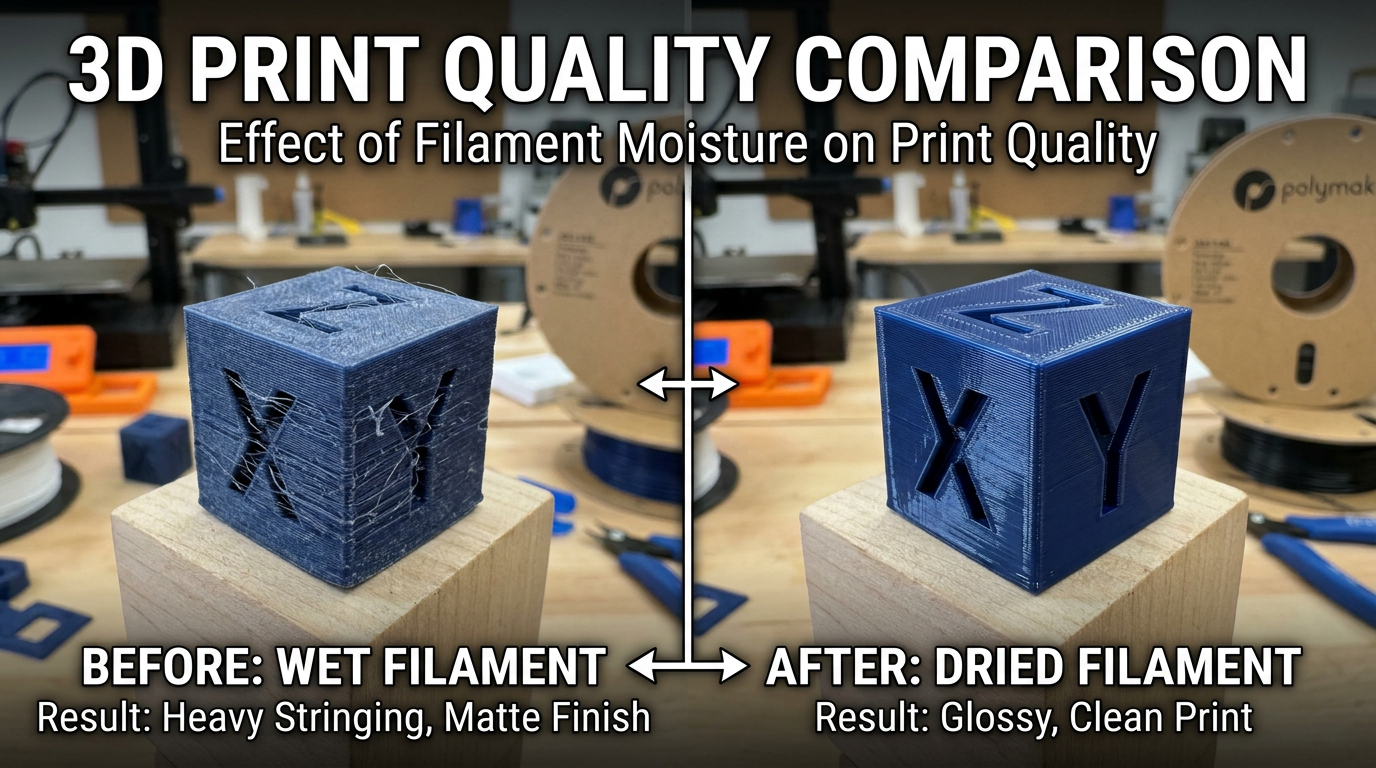
We tested a PETG spool left open in 55% RH for 10 days. Before drying: severe stringing and frosted finish. After 6 hours at 58°C in a Sunlu S2: glossy surface, no stringing. The spool was fully recovered. See our PETG dryer guide for the full before-and-after.
What to Buy: Dry Boxes, Containers, Hygrometers
Start with a hygrometer in your current storage. If RH stays above 50%, add silica or an active dry box. For regeneration, a Sunlu S2 or S4 is the right tool.
Holds one 1 kg spool. 70°C max, built-in fan, touchscreen with humidity display. Print-from-box via PTFE. Ideal for one printer. Recovers wet spools in 4–6 hours. We use this for PETG and PLA regeneration.
Amazon – Sunlu FilaDryer S2Holds four 1 kg spools. 350W PTC heater, three circulation fans, 70°C max. Best for multi-color printing or workshops. Intelligent humidity control. Print from any slot. Higher upfront cost but replaces four single dryers.
Amazon – Sunlu FilaDryer S4Plastic bins with gasket lids keep humidity out. Fit 2–4 spools per bin. Add silica gel and a mini hygrometer. Under $20 for a complete passive storage setup. Essential for long-term filament storage when not printing.
Amazon – Airtight Storage BinsMini hygrometers ($5–10 for five) show RH inside bins and dry boxes. Keep PLA and PETG under 50% RH. Place one in each storage bin. When the reading rises, replace or regenerate silica. Essential for monitoring filament storage.
Amazon – Digital HygrometersQuick Tips to Protect Your Filament
- Keep unopened spools sealed until use. Vacuum bags with desiccant last months.
- Check hygrometer weekly. If RH exceeds 50%, add silica or move spools to a dry box.
- Dry before printing if unsure. A 4-hour dry cycle costs less than a failed print and wasted filament.
- Regenerate silica, not just replace. Bake at 120°C for 2–3 hours. Saves money and reduces waste.
- Print-from-box for long prints. PETG and nylon absorb moisture during multi-hour prints. A dry box with PTFE passthrough keeps filament dry.
FAQ
- What are the best 3D filament storage solutions?
-
Short answer: Active dry boxes (Sunlu S2/S4) for drying and print-from-box; airtight bins with silica for passive storage.
Detailed: Active dry boxes heat and circulate air—they prevent moisture and regenerate wet spools. For bulk storage, airtight bins with silica gel and hygrometers cost $30–60 for 10 spools. Combine both: dry boxes for active printing, bins for sealed spools.
- How do I know if my filament is wet?
-
Short answer: Stringing, frosted surface, bubbles, popping sounds at the nozzle.
Detailed: Wet filament strings badly, prints matte instead of glossy, and may show tiny bubbles. You may hear popping or hissing as water flashes to steam. Dry the spool before continuing.
- What is the best dry box for filament?
-
Short answer: Sunlu FilaDryer S2 for one spool, S4 for four spools. Both heat to 70°C and support print-from-box.
Detailed: Sunlu S2 ($50–80) holds one spool with fan and touchscreen. S4 ($120–160) holds four spools with triple fans. Both regenerate wet filament in 4–6 hours. Eibos EasyDry and Cyclopes are alternatives.
- Can I use silica gel for filament storage?
-
Short answer: Yes. Silica gel in airtight bins keeps RH low. It prevents moisture but does not dry already-wet spools.
Detailed: Use 200–500 g silica per bin. Monitor with a hygrometer. Regenerate silica in an oven at 120°C when it turns pink or RH rises. Works for PLA and PETG in moderate humidity.
- How long does it take to dry wet filament?
-
Short answer: 4–6 hours for PETG and PLA. Heavily wet spools may need 6–8 hours.
Detailed: Set temperature by material: PLA 45–55°C, PETG 55–65°C, nylon 65–75°C. Run until RH in the dryer stabilizes or for at least 4 hours. Print immediately or store sealed.
- What humidity level is safe for filament storage?
-
Short answer: Under 50% RH for PLA, PETG, ABS. Under 30% for nylon.
Detailed: Use a hygrometer in each storage bin. If RH exceeds 50%, add silica or move to a dry box. Nylon absorbs faster—keep it in the driest storage you have.
- Is a filament dryer worth it?
-
Short answer: Yes if you print PETG, nylon, or live in a humid climate. One saved spool pays for a Sunlu S2.
Detailed: A $50 dryer recovers wet spools that would otherwise be thrown away. It also enables print-from-box for long prints. For PLA-only in dry climates, airtight bins with silica may be enough.
- Can I dry filament in the oven?
-
Short answer: Not recommended. Ovens have hot spots; filament can fuse into a blob.
Detailed: Kitchen ovens often overshoot by 20–30°C. PETG softens around 80°C. A $50 filament dryer is safer and more reliable. Food dehydrators work better than ovens but dedicated dryers dry more evenly.
- How do I regenerate silica gel?
-
Short answer: Bake at 120°C for 2–3 hours. It turns blue when dry. Reuse indefinitely.
Detailed: Spread silica on a baking sheet. Oven at 120°C. When beads turn from pink to blue, they are regenerated. Let cool before returning to storage. Silica lasts hundreds of cycles.
Conclusion
Filament storage protects your investment. Wet filament wastes money—prevent it with airtight bins and silica, or active dry boxes like the Sunlu S2 and S4. Regenerate wet spools instead of throwing them away. A hygrometer in each bin tells you when to act. For PETG-specific drying, see our best filament dryers for PETG. For cheap organization, our budget storage guide covers shelves and bins. Compare filament prices on our price tool.
Stop overpaying for 3D filament!
Compare brands and save today. Our tool shows real prices from Amazon, Ebay, AliExpress and manufacturer stores.
Compare brands & save today