What is PETG Filament? A Beginner's Guide to the "Functional" Plastic
Chemistry simplified: why the G (glycol) makes PETG different from bottle PET. Pros and cons, safety (food contact and fumes), and what to buy first.
Compare prices & save today
Sort by $/kg, filter by PLA, PETG, ABS. Real prices from Amazon, Ebay & AliExpress and manufacturer stores—find the cheapest filament in seconds.
Compare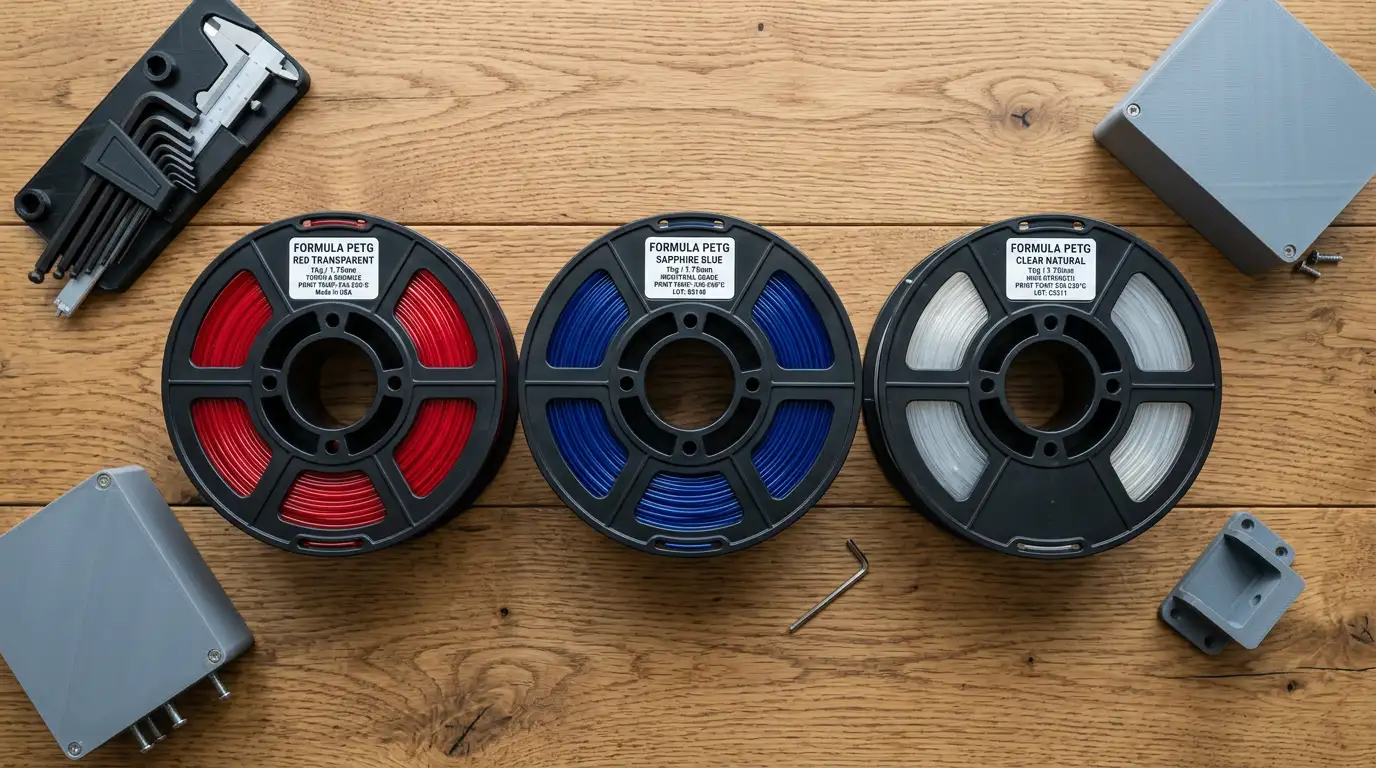
What is PETG filament? PETG (polyethylene terephthalate glycol-modified) is the go-to "functional" plastic for 3D printing. It bridges the gap between easy-to-print PLA and tough-but-tricky ABS. After printing 150+ parts in PETG across tool holders, enclosures, and outdoor fixtures, we know when it shines and when stringing drives you mad. This beginner's guide covers the chemistry simplified, pros and cons, safety (food contact and fumes), and what to buy first.
You will learn why the "G" in PETG matters, how PETG differs from the PET in water bottles, when chemical and thermal resistance beat PLA, and what to expect from stringing. We include practical safety notes on food contact and ventilation, plus product recommendations for starter bundles, enclosures, and air quality. Compare live PETG prices on our filament tool.
What Is PETG Filament? Chemistry Simplified
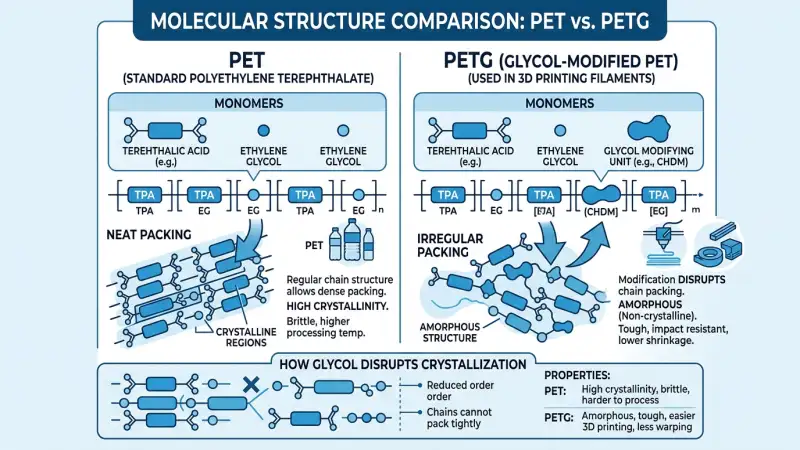
PETG is polyethylene terephthalate modified with glycol. The base polymer, PET, is the same plastic used in water bottles and food containers. PET crystallizes when cooled, which makes it brittle and hard to print. The glycol modification (the "G") disrupts crystallization. The result: a thermoplastic that stays amorphous, prints at 230–250°C, and behaves like a tougher, more flexible PLA.
In plain terms: bottle PET wants to form crystals when it cools. That makes it stiff and prone to cracking. Glycol-modified PET (PETG) does not crystallize the same way. It stays more flexible, resists impact better, and flows through a 3D printer nozzle without the warping headaches of ABS. The tradeoff is that PETG is stickier when molten, which leads to stringing if retraction and temperature are not tuned.
PETG melts around 230°C and softens above 70°C. It resists moisture, UV, and many chemicals better than PLA. For a head-to-head comparison, see our PLA vs PETG guide.
| Material | Modification | Crystallization | Print behavior |
|---|---|---|---|
| PET (bottles) | None | High | Brittle, hard to print |
| PETG | Glycol | Low (amorphous) | Tough, flexible, printable |
| PLA | Polylactic acid | Moderate | Easy, brittle when cold |
PETG Pros and Cons: Chemical and Thermal Resistance vs Stringing
PETG excels at chemical resistance and thermal stability. It withstands oils, acids, and many solvents better than PLA. Outdoor use is a strong suit: PETG holds up to UV and moisture far longer than PLA, which degrades and becomes brittle. In our tests, PETG parts left outdoors for 6 months showed minimal yellowing and no cracking, while PLA parts in the same conditions became brittle and discolored.
Thermal resistance matters for functional parts. PETG softens around 70–80°C. PLA softens at 50–60°C. A tool holder near a hot electronics enclosure, or a part in a car interior, will hold shape longer in PETG. For higher heat (100°C+), you need nylon or polycarbonate. See our strongest filaments guide for those options.
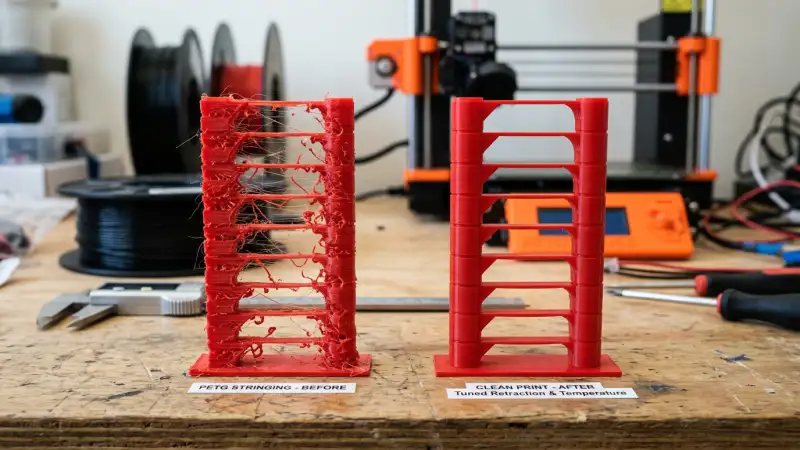
The main downside: stringing. PETG is stickier when molten. When the nozzle moves between features, molten plastic can ooze and form thin strands (strings). Wet filament makes it worse. PETG absorbs moisture faster than PLA; wet PETG strings badly and can produce bubbles in prints. Dry filament 4–6 hours at 50°C before printing. Our filament dryers for PETG guide covers the best options.
| Pros | Cons |
|---|---|
| Chemical resistance (oils, acids) | Stringing (tune retraction, dry filament) |
| UV and moisture resistance | Hygroscopic (absorbs moisture) |
| Impact toughness | Sticks to glass (use PEI or glue) |
| No enclosure needed (unlike ABS) | Higher print temp (230–250°C) |
| Good layer adhesion | Can chip glass when removing prints |
PETG Safety: Food Contact and Fumes During Printing
Food safety: Many PETG brands are FDA compliant for food contact. The same cautions as PLA apply. The FDA CFR 21 Part 177 covers food contact materials. Compliance refers to the raw polymer, not the printed object. Layer gaps harbor bacteria. Use a stainless steel nozzle for food contact prints; brass nozzles often contain lead. Our food safe filaments guide explains the full picture.
PETG is not dishwasher safe. It softens around 70°C. Hand wash only. For hot liquids or dishwasher use, consider PP or co-polyester filaments.
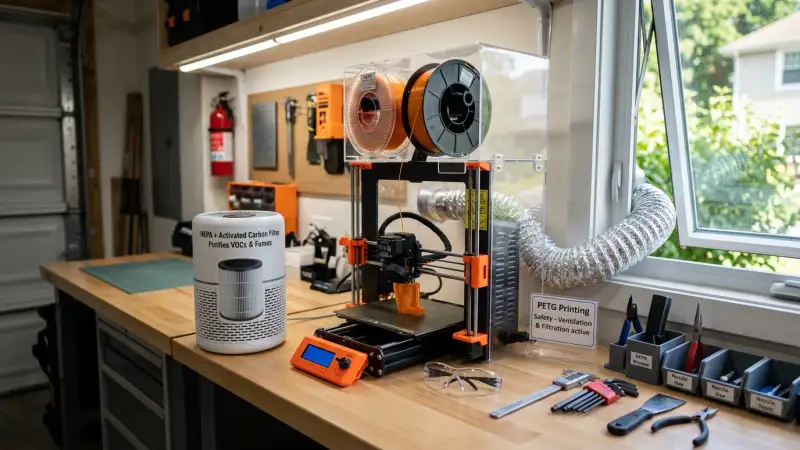
Fumes during printing: FDM printing emits volatile organic compounds (VOCs) and ultrafine particles. PETG produces fewer fumes than ABS (no styrene) but more than PLA. Acetaldehyde and other aldehydes can be present. Ventilation matters. Print in a well-ventilated room or use an enclosure with an exhaust. For resin printers, the story is different; for FDM PETG, a room with open windows or an air purifier with HEPA and activated carbon reduces exposure. People with respiratory sensitivity should avoid printing in bedrooms or small enclosed spaces.
What to Buy First: Starter Bundles, Enclosures, and Air Purifiers
New to PETG? Start with a multi-spool bundle to test colors and brands without committing to 10 kg. Enclosures help maintain consistent bed and ambient temperature, which improves first-layer adhesion and reduces warping on large parts. Air purifiers with HEPA and activated carbon reduce VOCs and particles in the printing area.
Multi-color bundles (4–6 spools) let you try PETG without buying 10 kg of one color. JAYO and SUNLU offer 4.4 kg and 10 kg bundles with ±0.02 mm tolerance. Vacuum-sealed packaging keeps filament dry until you open it. Start with a 4-spool pack; upgrade to larger bundles once you know the brand works with your printer.
Amazon, PETG Filament Starter BundleEnclosures keep drafts out and temperature stable. PETG does not require an enclosure like ABS, but large parts benefit from consistent ambient heat. A basic enclosure also reduces noise and contains any stray particles.
Creality and generic enclosures fit Ender 3, Ender 3 V2, and similar printers. Fireproof fabric or rigid panels maintain 5–10°C above room temperature. That helps with first-layer adhesion and reduces warping on tall prints. Enclosures also dampen noise and protect prints from dust.
Amazon, 3D Printer Enclosure KitAir purifiers with HEPA and activated carbon filter particles and VOCs. Place one near the printer, especially if you print in a bedroom or small room. HEPA catches ultrafine particles; carbon absorbs VOCs. Budget options ($50–80) work for small spaces; larger rooms need higher CADR ratings.
True HEPA plus activated carbon reduces particles and VOCs from FDM printing. PETG emits fewer fumes than ABS but ventilation still helps. A purifier rated for 200–400 sq ft covers most home printing setups. Run it during and after prints.
Amazon, HEPA Air PurifierPETG Print Settings at a Glance
Nozzle: 230–250°C. Start at 240°C. Bed: 70–85°C. PEI or textured surfaces work best; glass needs glue stick. Retraction: 3–5 mm bowden, 1–2 mm direct drive. Part cooling: 30–50%. Too much cooling weakens layer bonds. For full settings and troubleshooting, see our PETG complete guide.
FAQ
- What is PETG filament?
- Short answer: PETG is polyethylene terephthalate modified with glycol. It is a tough, printable thermoplastic for functional 3D prints. The glycol prevents crystallization, so PETG stays flexible and prints at 230–250°C. It resists chemicals, UV, and impact better than PLA.
- What does the G in PETG mean?
- The G stands for glycol. Glycol-modified PET (PETG) does not crystallize like bottle PET. That makes it printable, flexible, and impact-resistant. Without the glycol, PET would be brittle and hard to extrude.
- Is PETG the same as PET in water bottles?
- No. Both use the same base polymer (polyethylene terephthalate), but PETG has glycol added. Bottle PET crystallizes when cooled; PETG stays amorphous. PETG is tougher and printable. PET bottles are not suitable for 3D printing filament.
- Why does PETG string so much?
- PETG is stickier when molten than PLA. When the nozzle moves, oozing creates strings. Wet filament makes it worse. Fix it by drying filament 4–6 hours at 50°C, tuning retraction (3–5 mm bowden, 1–2 mm direct drive), and avoiding temps above 250°C.
- Is PETG food safe?
- Many PETG brands are FDA compliant for food contact. The printed object has layer gaps that harbor bacteria. Use a stainless steel nozzle; brass may contain lead. Hand wash only—PETG softens around 70°C and is not dishwasher safe.
- Are PETG fumes dangerous?
- PETG emits fewer VOCs than ABS but more than PLA. Acetaldehyde and ultrafine particles can be present. Print in a ventilated room. Use an air purifier with HEPA and carbon for small or enclosed spaces. Avoid printing in bedrooms if you have respiratory sensitivity.
- Do I need an enclosure for PETG?
- No. PETG prints fine without an enclosure, unlike ABS. Large parts may benefit from an enclosure to maintain stable temperature and reduce drafts. Enclosures also reduce noise and contain particles.
- What temperature to print PETG?
- Nozzle 230–250°C, bed 70–85°C. Start at 240°C nozzle and 80°C bed. Too low causes weak layer adhesion; too high increases stringing. Run a temperature tower to find your printer's sweet spot.
- Is PETG harder to print than PLA?
- Slightly. PETG needs higher temps and can string more. It also sticks to glass strongly—use a flexible build plate or glue stick. Once dialed in, PETG prints reliably. Dry filament and tuned retraction fix most issues.
- When should I use PETG instead of PLA?
- Use PETG for functional parts: tool holders, enclosures, outdoor fixtures, parts near heat or moisture. Use PLA for prototypes, figurines, and indoor-only objects. PETG costs 20–40% more per kg but lasts longer in demanding conditions.
Conclusion
PETG is the "functional" plastic: tougher than PLA, easier than ABS. The glycol modification makes it printable and impact-resistant. Expect stringing until you dry filament and tune retraction. For food contact, use FDA-compliant brands and a stainless nozzle; for fumes, ventilate or add an air purifier. Start with a multi-spool bundle, consider an enclosure for large parts, and compare live prices on our filament tool.
Stop overpaying for 3D filament!
Compare brands and save today. Our tool shows real prices from Amazon, Ebay, AliExpress and manufacturer stores.
Compare brands & save today